The Mendocino Voice: On Mendocino Ridge, a winemaker says wine’s real problem is trust
The Mendocino Voice: On Mendocino Ridge, a winemaker say’s wines real problem is trust

by Roger Coryell of the Mendocino Voice
Mendocino County is wine country’s best-kept secret, and the proof is in the map. Tucked into one rural county is a baker’s dozen of distinct American Viticultural Areas — 13 federally drawn appellations, each its own argument about soil, fog, elevation and grape. They range from the smallest AVA in the entire country to a scattering of vineyards perched on ridgetops so high they sit above the clouds — islands in a sea of fog. Over the next 13 months, we’ll walk the county appellation by appellation: the ground, the climate, the grapes that found a home there and the growers betting on them.
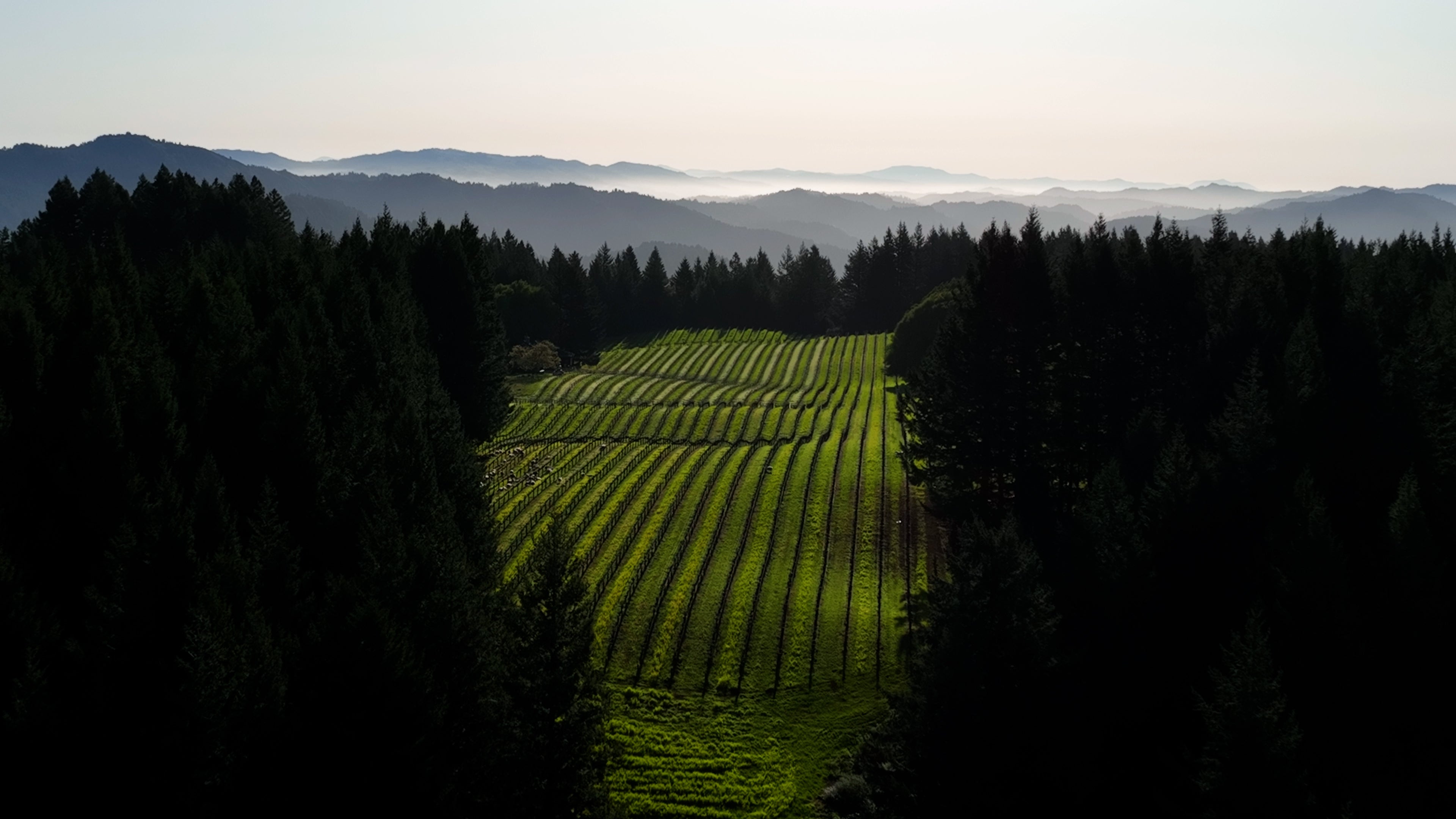
Above the fog line, the air is clear, and the dirt is clean. Growing the wine was never the hard part.
The fog stays below, pooled in the valleys, while the vineyards sit on top of it like islands — which is how the ridge earned its nickname, Islands in the Sky. Only the ground above about 1,200 feet makes the appellation, so what’s left is a scatter of vineyard patches stranded on ridgetops over a sea of fog. Up here there’s no chemical drift, because there’s nothing on any side but forest. Mariah Vineyards has worked one of these islands since 1979, dry-farmed and never irrigated. What the family does now goes further — no synthetic chemicals in the vineyard, every wine lab-tested for traces of more than 500 of them. It’s about as clean and honest as a wine grape gets in California.
And Michael Frey still can’t sell you on “clean.”
Not because the wine isn’t good. Because the word wore out. “Regenerative,” “sustainable,” “natural” — they’ve been stuck on so many bottles, by people doing wildly different things, that a shopper has no way to tell which ones mean anything. Frey, who farms Mariah with his wife, Nicole, thinks the wine business has spent years trying to fix the wrong problem.
“Certifications are a substitute for trust,” he says. “I don’t think we have a certification problem. We have a trust and transparency problem.”
His bet is that the way back is to stop hiding — to show people exactly what’s in the bottle and how it was grown, put the proof in front of them, and trust them to care.
Frey is Swiss, and he’ll tell you so before you can ask about the accent. He left a hospitality career in his mid-30s to travel, met Nicole Dooling in Peru, and followed her home to California. Nicole’s parents, Dan and Vicki Dooling, planted Mariah on this ridge in 1979 and pulled their first crop in 1983. Nicole grew up here. Today she’s an emergency nurse in San Francisco; the couple lives in the city and drives up the spine of the North Coast to farm. What grows up here is what the market kept asking for: the old original vines still on the hill, four French Dijon clones of pinot noir, Italian and French clones of chardonnay, some sauvignon blanc, a little primitivo. The whole place is dry-farmed — not a drop of irrigation — and it has been for more than 40 years. The ridge does the rest. 95% of the time the vineyard sits above the fog. The Pacific is five or six miles off. A steady wind keeps mildew down. The soil runs 8% to 12% organic matter, not because anybody worked a miracle but because it used to be forest.
It’s all about ‘show me.'
Frey can talk about soil chemistry for an hour, but his actual argument is simpler. “Farming is all about show me,” he says. “You can read a million papers, but your neighbor has to do something, and you want to go see it.”
That instinct has a name now. The One Block Challenge, run by the Regenerative Viticulture Foundation. The One Block Challenge asks a grower to set aside a single block of vines, try a handful of regenerative practices on it, and run simple tests in the dirt — earthworm counts, water infiltration, how hard the soil is packed. Every couple of months the group walks through one another’s blocks and trades what worked and what flopped. It started in Paso Robles in early 2025 with 46 growers and has since spread to Napa and beyond. It’s Frey’s “show me” built into a standing invitation: growers showing growers, and measuring the differences instead of arguing about them.
Mendocino has its own cohort now. It launched this spring at Bonterra’s McNab Ranch, outside Ukiah, where the regenerative growers who turned out came mostly to learn one thing — how to measure what they were already doing.
Mariah’s own road started earlier, at a 2017 lunch in Healdsburg with Paul Dolan, the Mendocino winemaker who turned Fetzer organic and spent the back half of his career preaching that a vineyard could rebuild the ground it stands on. Frey calls Dolan a mentor. The pitch — that you could restore an ecosystem and still put a product in a bottle — lit him up enough to go home and ask his in-laws whether the family could actually try it. “A rabbit hole ever since,” he says. “Screwing up along the way. It’s the best way to be successful along the way.”
In 2020 Mariah became the pilot — and then the first vineyard anywhere — to earn the Savory Institute’s Land to Market verification, an outcome-based seal that measures soil health and biodiversity instead of policing which practices you use. Frey likes that distinction. A practice that works at 2,400 feet with 90 inches of rain, he points out, means nothing in Paso Robles. Measure the result, then adjust.
So they did the things everybody lists first — diverse cover crops, sheep, hedgerows, pollinator habitat. Then they kept going. They started running sap analysis on the vines, a kind of blood draw that flags nutrient gaps the soil tests miss. They switched to gentler “sap pruning.” They seeded plant families, not just species, after listening to soil scientist Christine Jones argue that 10 different clovers compete while 10 different families cooperate. They learned that a flowering plant every 20 meters — about 65 feet — keeps beneficial insects working the rows, a number that traces back to UC Berkeley research by Miguel Altieri.
Everything bends to one word, which Frey repeats like a drumbeat: biodiversity. “The more biodiversity below ground, the more biodiversity above ground. The more life, the more resilient.” And resilience, up here, is the whole game now. He ticks through the seasons: 2023 was the coldest he’s seen, budbreak weeks late; 2024 brought the hottest July and cooked fruit all over the county; 2025 hammered the ridge with wind; 2026 opened with an early budbreak, a hot March, a cold snap and shatter in the vines. “There’s no blueprint for how you farm a season anymore,” he says. “The challenge is to build a system that can deal with all of that on its own.”
The $2,000 problem
The wine in your glass is the easy part. Selling the grapes is where the ridge bleeds.
Up and down the county, growers are sitting on vineyards they can’t afford to farm — pests nobody can afford to spray, fruit nobody can afford to pick, stuck in a hole because the grapes won’t sell. Does it reach his own neighbors on the ridge?
“Everybody,” he says.
He’ll tell you Mariah’s fruit is special, and he’s not wrong: dry-farmed, chemical-free, verified regenerative, with no neighbor close enough to drift anything onto it. “We’re at the end of the world,” he says. None of it matters when there’s fruit on the open market from Napa at $2,000 a ton. “You can have the best grapes in the world. It is extremely hard to sell.” Growers are struggling, he says, and the ones who only grow — who don’t make their own wine — are struggling worst.
That’s the wall the family ran into, and it’s why DIRT Wine exists. The name stands forDirectly Impacts Regenerative Transformation, which sounds like a mission statement because it is one. The brand grew out of the same frustration that drives the rest of Frey’s talk: that “regenerative” now means whatever a marketing department wants it to mean.
“You can spray herbicide and call yourself regenerative,” he says. “Or you can be biodynamic and call yourself regenerative. Natural wine isn’t defined either — you can do whatever you want and call yourself natural wine.”
His answer is to put the cards face up. DIRT’s bottles carry one declared addition — a touch of sulfite — against the roughly 76 additives Frey says federal rules let a winemaker pour in without listing a single one. The wines ferment on native yeast, with no added sugar. Every wine gets lab-tested for more than 500 chemical residues, glyphosate included, partly because Frey genuinely wants to know whether anything is sneaking into a vineyard he believes is clean. The company posts its soil data, its sap data and its residue results on a transparency page and lets you make up your own mind. It works with the Community Alliance with Family Farmers and Zero Foodprint.
“We believe consumers deserve to know what they drink,” Frey says. “It’s an uphill battle.”
His sharpest complaint is the one a lot of North Bay drinkers will recognize. “It’s crazy that we speak about sustainability and then go spray Roundup on the vines and can still get the certification,” he says. Sonoma County is wall-to-wall with the same greenwashing. “All over the place,” he says.
Frey keeps circling back to a generation of younger drinkers who turn every grocery label over to read it. Wine, he argues, is the one agricultural product that gets a pass — only sulfites have to be declared, while the rest of the list stays hidden. He’d put an ingredient label on a bottle tomorrow and see what happens. He brings up Velcorin, a wine sterilant so toxic that the people who add it suit up in protective gear. It breaks down into simpler compounds, he allows — “but do you really want something in your wine that people have to wear a hazmat suit to put in?”
The untold story
The harder question is what makes Mendocino worth seeking out at all — and Frey turns it around as fast as it’s asked. What makes it different from Lodi? From Napa? Why should the words “Mendocino County” on a label mean anything to a 35-year-old standing in a Safeway in Orange County, boggled by a wall of brands owned by a handful of companies?
He’s not sold on the county stamp alone — the conjunctive labeling that now puts “Mendocino County” on local bottles. “I don’t think that just because you write Mendocino County on a bottle, that really changes something,” he says. “You have to market yourself. You have to convince with good wines.” What he believes in is the story underneath it — to his mind, the greenest county in California, a place with no chemical drift because the vineyards sit on top of everything, farmed by people doing genuinely different things. He rattles off three of them — the Frey family of Frey Vineyards (no relation), biodynamic and organic pioneers; Bonterra, regenerative organic certified; Mariah, Land to Market verified. Three certifications, three different philosophies of what the word should mean.
“It’s sad that Mendocino Ridge is always a bridesmaid,” he says. The fruit goes to Napa, goes to Sonoma, goes everywhere but onto a label that says where it grew. (The appellation itself is mid-makeover: local growers have petitioned the federal government to rename it “Mendocino Coast Ridge,” a change Frey notes can take the better part of forever.) “There’s tremendous potential up here.”
Which is the same argument he started with, just pointed at the county instead of the bottle. The grapes are good. The farming is real. The problem is that nobody outside the ridge knows it, and the fix isn’t a stamp or a seal — it’s telling people the truth and trusting them to care.
“If you really know what’s happening, and you can make your own picture,” Frey says, “then who cares if you call it regenerative or not?”
This is the first in an occasional series visiting Mendocino County’s appellations one at a time.
Mendocino growers can join the county’s One Block Challenge cohort, which launched this spring at Bonterra, through the Regenerative Viticulture Foundation at regenerativeviticulture.org.
This article first appeared on The Mendo Voice.